Wright Wellness Website: What Changed and Why
Updated
A documented website case study: service navigation, welcoming copy, and team browsing for an Arlington practice, with current screenshots and a clear relationship disclosure.
A practice website needs to help someone understand the services, meet the people behind them, and find a next step. This case study examines how the Wright Wellness website organizes those decisions.
Our relationship: Elaren Studio is credited as the site’s designer. Felix Torres, Elaren’s Director, also serves as Wright Wellness’s Operations Manager. This is a project with a direct working relationship, not an independent client testimonial. The work described here concerns website design, content presentation, and implementation; it does not establish clinical authorship or clinical outcomes.
The brief in practice
Wright Wellness is a mental health and wellness practice in Arlington, Texas. Its website connects several services with individual team profiles and an appointment-request route. The design challenge is to provide that range of information while keeping the first visit approachable.
Before and after: documented changes
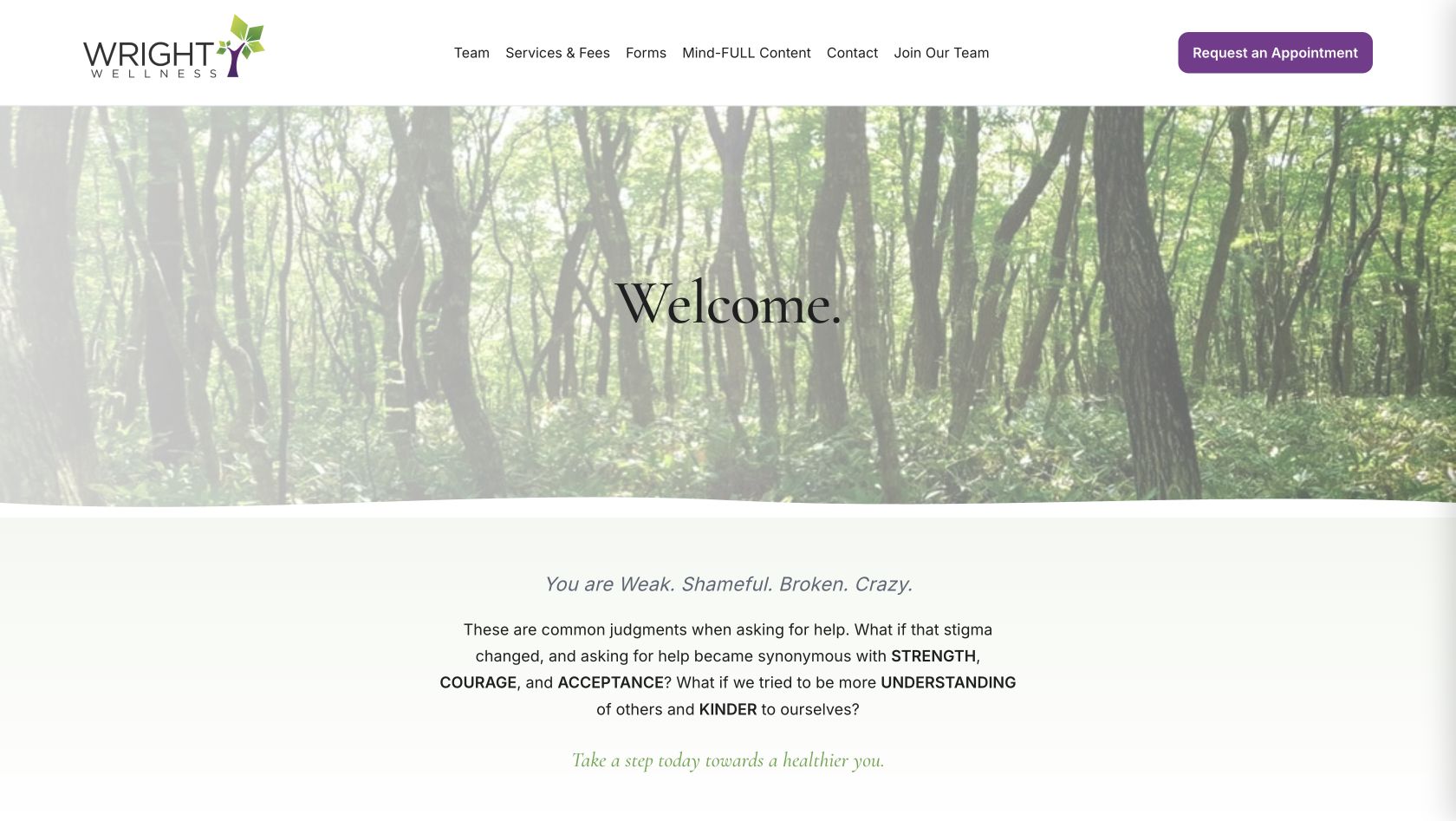
The comparison below uses retained website source history and the current public page. It is not a comparison of measured conversion rates. The screenshots show the current site; no verified screenshot of the earlier live homepage was available for this review.
| Element | Earlier implementation | Current implementation |
|---|---|---|
| Homepage introduction | A longer welcome heading, reflection, and appointment, phone, and Spanish links appeared together in the hero. | A short welcome heading and separate reflection introduce the practice, with an appointment-request button in the header. |
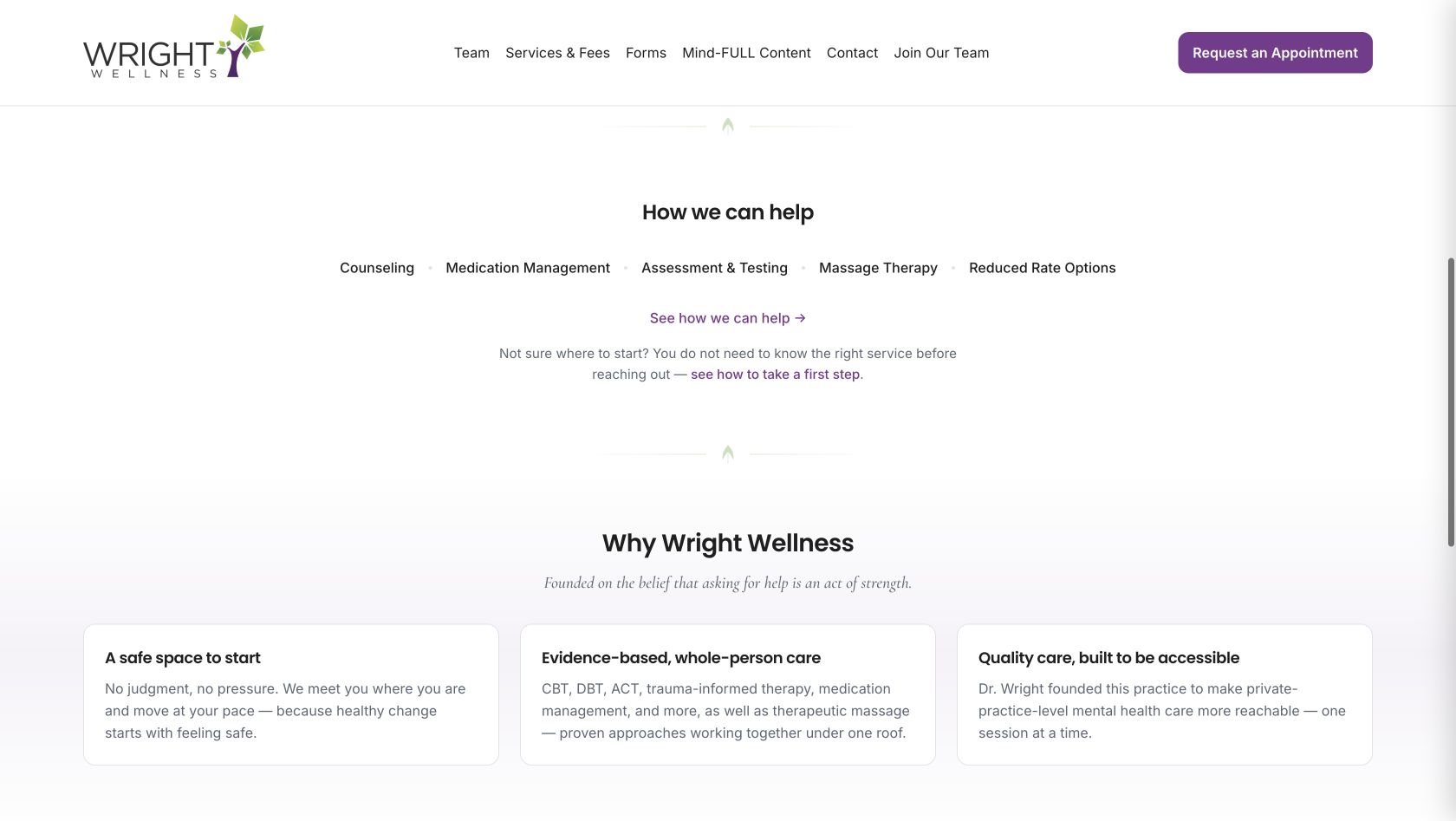
| Service navigation | A grid of service cards included descriptions and individual service links. | A compact service list links to dedicated pages, with an overview and a separate starting-point link. |
| Choosing a next step | The service overview link existed on its own. | A June 2026 update added guidance for visitors who are unsure which service to choose. |
| Team browsing | An earlier team preview used an automatically scrolling presentation. | The team preview has arrow controls and touch scrolling, with links to individual profiles. |
Both earlier and current versions have headings, service information, and contact paths. The change is in their organization and presentation. It would be inaccurate to describe the earlier site as lacking an H1 or having no useful service structure.
A specific writing change
The service section now tells visitors:
“You do not need to know the right service before reaching out”
That sentence addresses a concrete uncertainty: a visitor may be ready to ask for help without knowing which service label fits. The adjacent link leads to the starting-point explanation on the services overview. This is an example of connecting copy to a useful destination, rather than adding another general contact prompt.
Implementation details that support the experience
The retained change history documents the February 2026 homepage restructuring, March team-carousel controls, and June starting-point guidance. Team images include names as alternative text, explicit image dimensions, and lazy loading. These are verifiable implementation details, not a complete accessibility certification or a measured speed improvement.
The short “Welcome” heading is a design choice with a tradeoff: it communicates tone but does not explain the practice’s services or location by itself. Service pages, navigation, and contextual copy must carry that information. A next iteration could test a more descriptive introduction while preserving the practice’s voice.
What this example proves
It shows real design work, a documented writing change, and the ability to maintain a functioning public website over time. It does not establish increased search rankings, appointment requests, revenue, or patient outcomes. Those would require separately verified measurements.
This is a broader website implementation example, not a promise to redesign an entire site within the $495 local SEO month. For a smaller starting point, read what the first month of local SEO includes, then request a scope check. For ongoing writing across your website, social channels, and email, see content marketing.
Evidence reviewed September 8, 2026: public homepage and service navigation; retained source changes from February 4, March 13–15, and June 10, 2026. The original February article was substantially revised to match that evidence. No private customer or patient information is included.
Related resources
How Much Does a Website Redesign Cost in 2026?
Real cost ranges for service business website redesigns in 2026 — from DIY to agency. What drives the price, hidden costs, payment models compared, and how to evaluate whether it's worth it.
GuideShould a Small Business Start With SEO or Social Media?
A practical decision guide for choosing between a focused local SEO engagement and a content and social publishing batch.
GuideHow Long Does a Website Take in 2026? Real Timelines and Common Delays
Honest timelines for service business websites in 2026 — from landing pages to full builds. What each phase takes, the seven delay killers, and how to launch in 10 days instead of 10 weeks.